
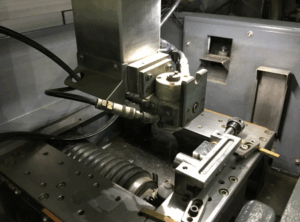
Wire-Cutting Electrical Discharge Machining (EDM) is where engineers turn when a conventional cutter simply can’t reach. Whether you’re chasing knife-sharp internal corners or hair-thin ribs, the process relies on two things: a charged brass (or zinc-coated brass) wire and a first-class electrode material. At Graphel Carbon Products, we’re often asked which graphite grades make the cut, so we sat down with our own Bill Heyser, Engineering & IT Manager, and industry partner Marc Sanders of Entegris | POCO Materials to get the facts.
How Wire-Cutting EDM Works
“In Wire EDM, electrically charged wire (typically brass or zinc-plated brass) is used to cut shapes into graphite (or other conductive materials),” says Heyser. “The advantage of wire-cutting graphite electrodes is that you can create thinner, more delicate geometry in the graphite than you can using conventional machining methods. Also, you can create sharper corners than a mill can create. Wire EDM machines can generate tapered or angled surfaces on the inside or outside of the part geometry.”
Because the wire never makes physical contact, heat-affected zones are virtually eliminated. The spark erodes the graphite while cooling water flushes debris away, leaving a clean, precise edge ready for the next operation.
Why Dense, Fine-Grain Graphite Wins
“Typically, dense grades of graphite material work the best for wire EDM as the cut consistency is maintained throughout the burn surface as the wire cuts through the material,” says Heyser.
Dense graphite’s uniform structure keeps material removal smooth and predictable, even on complex electrode profiles. Fine-grain variants also resist chipping, so your geometry stays intact from first spark to final pass.
Marc Sanders agrees:
“The higher quality the graphite the easier it is to Wire EDM. Uniform particle size and material structure are key elements to consider when choosing a material for Wire EDM. Copper Graphite grades such as EDM-C3 wire cut quite well due to the lower electrical resistivity from the addition of copper into the open porosity. For standard graphite, we recommend 1 or 5-micron grades such as EDM-AF5 or EDM-3.”
Know the Process Limits
“One limitation of the wire EDM process for making graphite electrodes or parts is that the material must be conductive,” says Heyser. “Additionally, that part can’t be too thick as there are height limitations to the wire EDM machines themselves and cutting becomes more difficult as thickness increases. Good flush on the part of the wire EDM machine is required throughout the cut; otherwise, constant wire breakage will occur. The thicker the part gets, the more difficult it is to flush through the cut.”
In other words, think ahead:
Conductivity – non-conductive materials are off the table.
Part height – stay within your machine’s Z-axis window.
Flushing – design in ports or reliefs if the geometry is deep.
And finally:
“Intricate electrodes are usually the only type of electrodes that are cut this way.”
Slow cycle times make wire EDM overkill for simple blocks—save it for the geometries no other method can achieve.
Ready to Optimise Your Next Electrode?
Our engineering team has helped UK manufacturers across aerospace, medical and hermetic sealing projects squeeze every micron of accuracy from their EDM programmes. Use the Live-Chat feature on our site or phone us directly to discuss grades, tolerances and lead-times. We’ll keep you sparking—and keep your corners crisp.


